
DEEP
About DEEP
The DEEP system, which is currently under development, will enable rapid retrieval of data relevant to emergency teams and fire brigades working at decentralised power plants such as wind turbine generators, ground-mounted solar plants or biomass power plants. Following an accident, plant failure or even injury to people on site, emergency control centres will be able to access maps with location and site-specific information to enable efficient and immediate deployment of the emergency services.
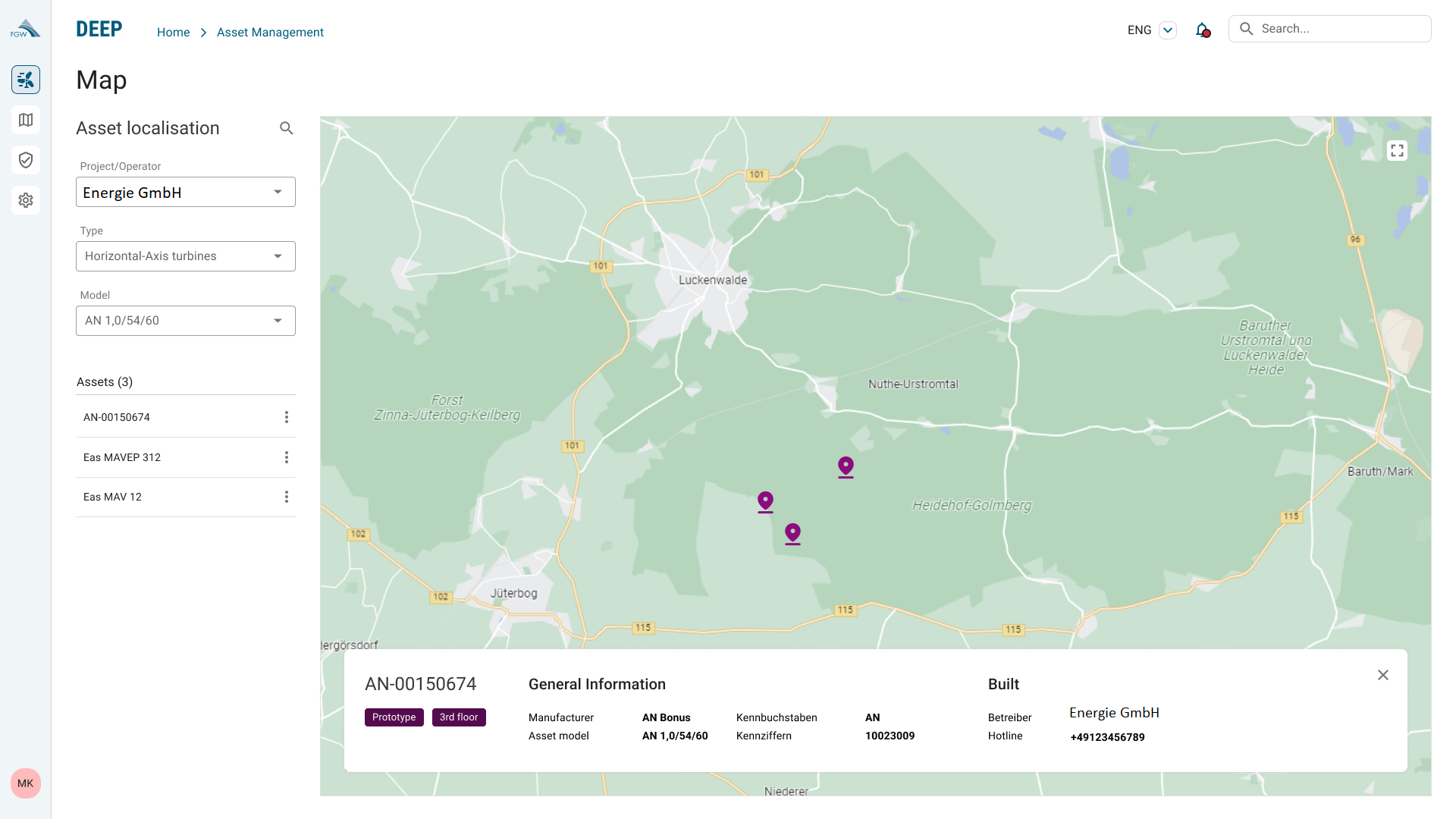
Complete map of all plants
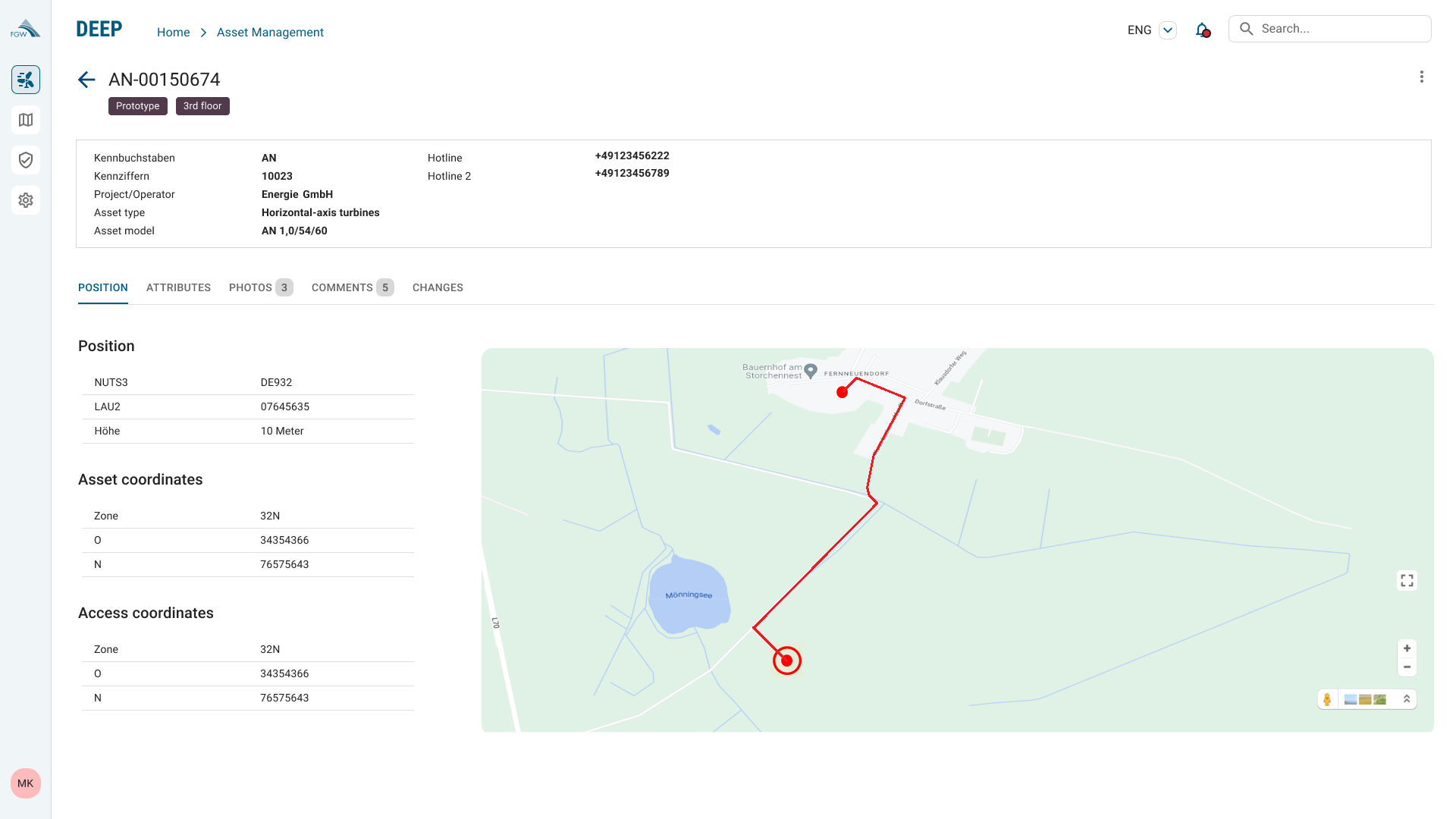
View of plant details with access road
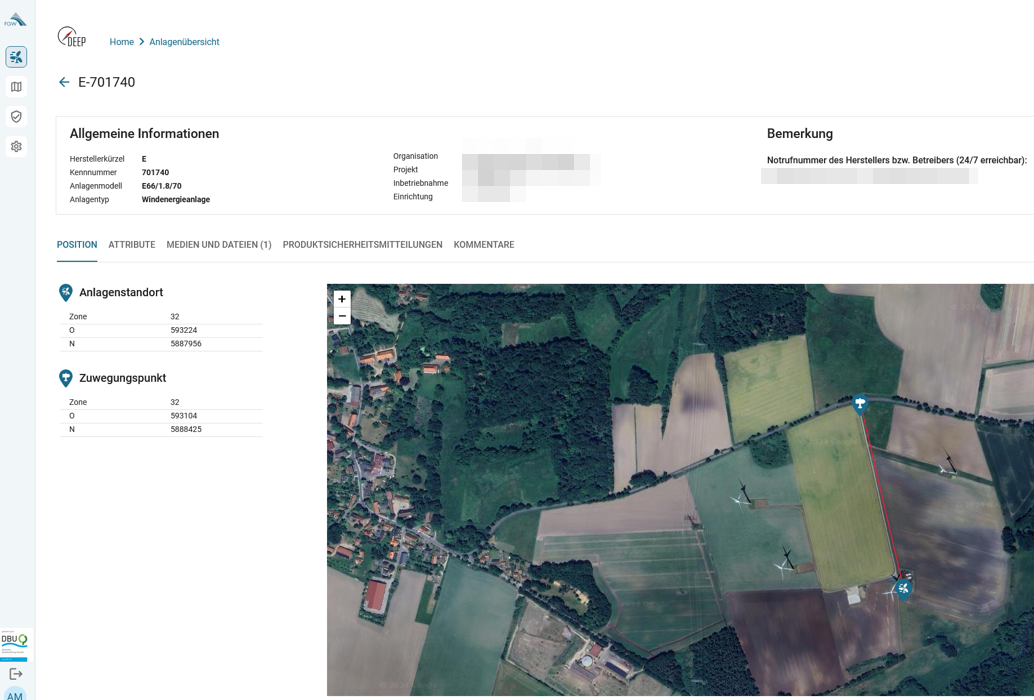
Plant details
The System
DEEP is based on the German ‘Windenergieanlagen-Notfall-Informations-System’ (WEA-NIS), which offers the above-mentioned services for wind turbines. More than 18,000 turbines are currently registered in this system, which covers almost 65% of German onshore wind turbines. All registered emergency call centres are automatically assigned to the turbines via their NUTS/LAU area code and have free access to the relevant information. The turbines registered in WEA-NIS are automatically ported to the successor system at no cost to the operators.
System Scope
In addition to wind turbines, all other decentralised energy generators, switchgear and transformers are also integrated into DEEP. Additional system profiles can be easily added via a dynamic input interface.
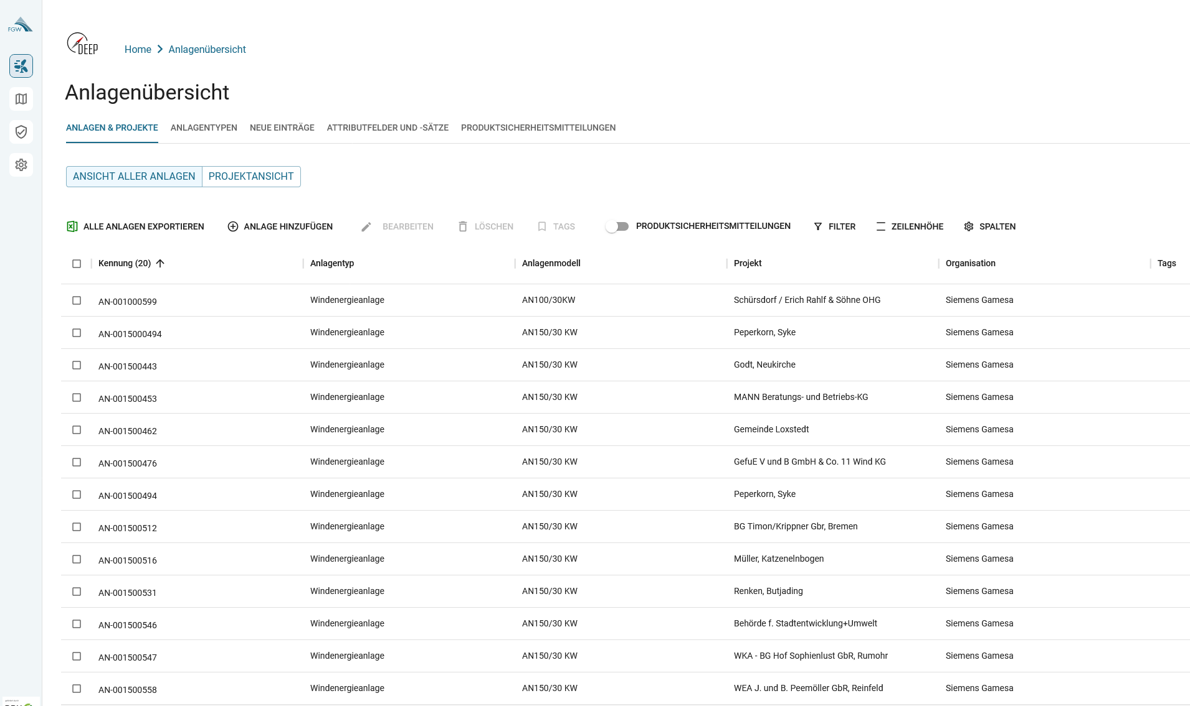
Overview
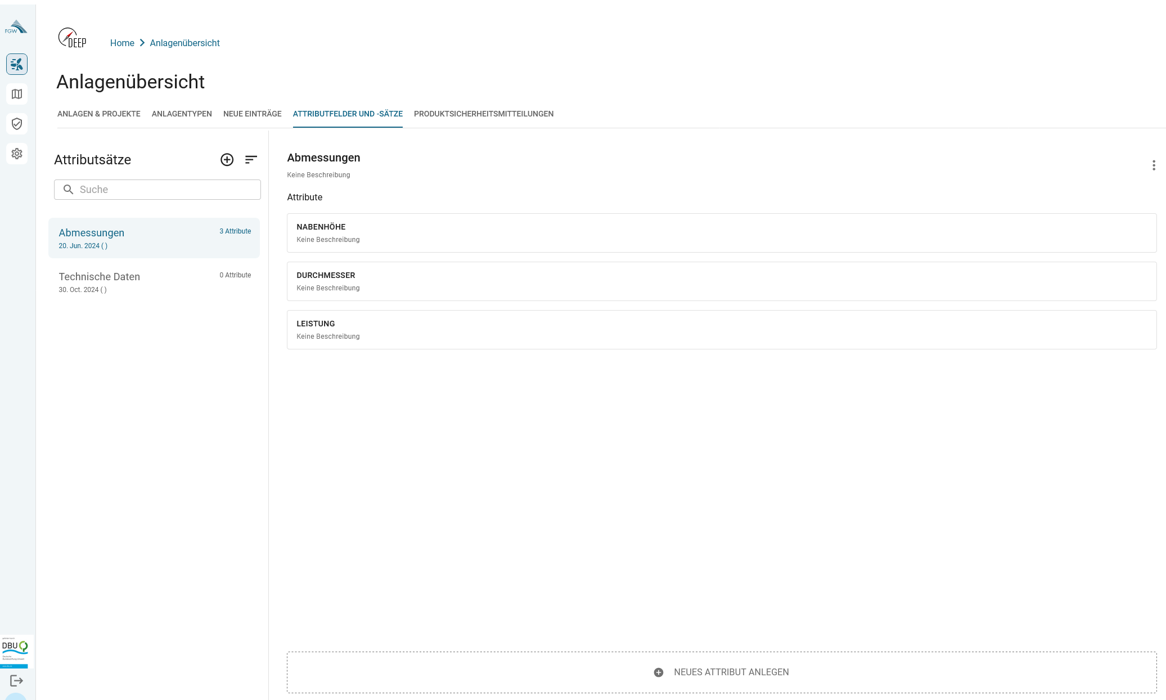
dynamic input interface
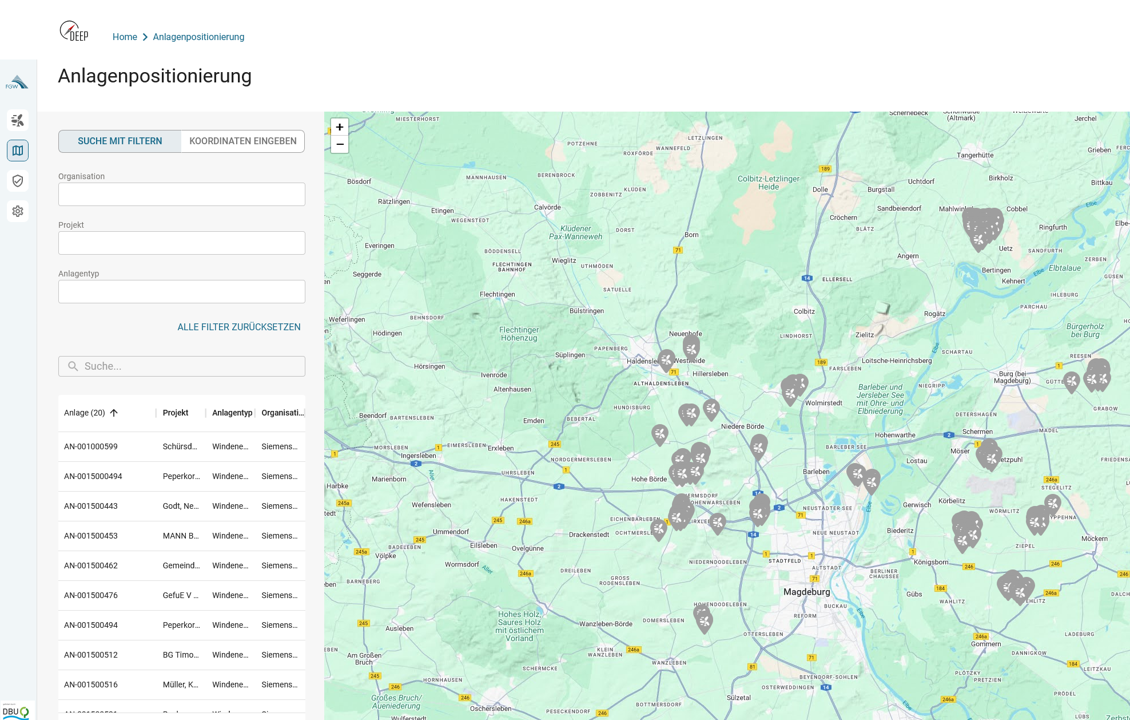
map view
Safety Alerts
Product safety alerts are automatically and discreetly distributed to all affected system operators as soon as a component fault is detected. The severity of the warnings is checked and assessed by an independent control committee of experts before they are forwarded to the operator. The product safety messages (PSM) issued by the manufacturers are collected and allocated centrally.
Sponsors


Projektlaufzeit: 01/2023 - 06/2024
DBU-Aktenzeichen: 37889/01-24


Fees
The current fee schedule is based on the superseded Wind Turbine Emergency Information System (WEA-NIS).
Fees of EUR 35.00 per system will be charged for the entry of system data and EUR 25.00 per system for the correction of data if FGW e.V. is commissioned to carry out this work. The fees do not apply if users carry out the work themselves.
An annual user fee is also charged. These fees are staggered according to the number of facilities managed as follows:
| Base price for each individual invoice item | EUR 60.00 | incl. unit 1 to 5 |
| unit 6 to 10 | EUR 10.00 | per unit |
| unit 11 to 100 | EUR 5.00 | per unit |
| unit 101 onwards | EUR 2.00 | per unit |
FAQ
What is DEEP?
The “Decentralised Energies Emergency Platform” system provides information that is relevant for emergencies at and around decentralised power generating systems (PGS).
This includes emergency contacts, locations and access routes (plus information on possible obstacles), technical data, etc.
Who is using the system?
Control centers, fire departments, height rescue groups, disaster control, etc., in other words all institutions involved in the protection of people and facilities.
Who can access the data in DEEP?
Only registered users can view the data in DEEP. The scope depends on their user role:
- Power generating system (PGS) operators can only view and edit their own systems.
- Control centers and rescue services have full access to data of all PGS so that they can use it to support their rescue operations.
How do I register my wind turbine in DEEP?
To register and manage your own wind turbine in DEEP, please first register with the role of “turbine operator” at www.portal.deep-fgw.net. Once your account has been successfully checked and approved by FGW e.V., you can add and manage your new turbines.
How do I assign installations formerly registered in the WEA-NIS to my operator organization?
If your installations were already entered in the WEA-NIS (predecessor of DEEP) but are not displayed in your new DEEP account, please send us an e-mail to info@deep-fgw.net with a list of the installations belonging to you, including a document stating that your organization is the operator of the installations. FGW e.V. will then assign the systems to your account. will be assigned to your account.
What information must be provided for the registration of a wind turbine generator (WTG)?
The following mandatory information is required when registering a new wind turbine:
- Name of the organization (the organization of your operator account is automatically adopted here)
- Project name (e.g. wind farm name)
- Billing address
- System identification number
- System model and its technical data
- Access point and location of the power generating system (PGS)
- Route between access point and location (must be drawn on the interactive map)
- Emergency contact
Optionally, you can also add the following information:
- Date of installation and commissioning
- Upload files, such as pictures of the route to the PGS or the system itself
- Product safety notifications
- Add further comments in the comments field
Can I also enter other power generating systems (PGS) than wind turbines in DEEP?
DEEP’s predecessor system WEA-NIS only listed wind turbines, which is why DEEP initially only included wind turbines. As a new feature of DEEP, however, all decentralized energy plants and units can be entered into the system so that emergency services can use the DEEP to support their operations at these as well.
How can I update the data of my PGS in DEEP?
As a system operator, you can edit the data of your systems yourself and thus update the system data quickly and easily.
What are the advantages of registering my PGS in DEEP?
- Emergency services have fast and targeted information in an emergency case
- Standardized and secure data maintenance of your systems
- Fulfillment of requirements for operator responsibility and safety documentation
- Central platform for managing and updating system data
What does a membership cost?
Control centers, fire brigades, height rescue groups, disaster control etc. use DEEP free of charge.
Operators are charged a fee of EUR 35 per turbine for the registration of the WTG data. For the transfer of an existing WTG in the DEEP to a new user or for data corrections, fees of EUR 25 per installation are charged. The latter are not charged if the operators carry out the work themselves.
An additional annual usage fee is charged for continuous operation. This is staggered according to the number of managed PGS as follows:
- Base price: EUR 60.00 for the first 1 to 5 WTGs.
- for WTGs 6 to 10: EUR 10.00 per WTG.
- for WTGs 11 to 100: EUR 5.00 per WTG.
- for WTGs 101 onwards: EUR 2.00 per WTG.
The fees do not include the statutory value added tax.
How do I pay the fees?
When registering systems, it is necessary to provide a billing address. FGW e.V. will send an invoice to this address, which your organization will pay on account.
History
1997
The first German wind farm on the west coast goes into operation [1]
2001
Foundation of AKSIWE
At the wind trade fair in Husum in September, the AKSIWE working group for safety in wind energy is founded, which is made up of employees from manufacturers and suppliers of wind turbines [2]. An FGW working group develops a concept for a standardised, centralised WTG register. Both groups together formulate the research project for the realisation of the WEA-NIS [3].
2002
WEA-NIS available online
The Wind Turbine Emergency Information System 1 (WEA-NIS) goes online and is operated by FGW e. V. [4]. It was previously developed by trained manufacturer employees as part of a research project. Funding was provided 50% by the Federal Environmental Foundation and 25% each by the BWE and members of the AKSIWE [2].
2023
Development of the successor platform DEEP begins
After more than 20 years of WEA-NIS operation, the DEEP project will be launched in January. DEEP (“Decentralised Energies Emergency Platform”) is to become the successor platform to the WEA-NIS and modernize it so that the workflow, the effort involved in maintaining the system and the availability for users are optimized and adapted to the latest standards. The German Federal Environmental Foundation (DBU) will cover 80% of the modernization costs and the remaining 20% will come from the revenue generated by the WEA-NIS itself.
2024
Development of the successor platform DEEP begins
In the course of 2024, DEEP will replace the WEA-NIS and the data will be transferred from the old to the new system and revised.
2025
DEEP replaces WEA-NIS
After initial parallel operation of both systems, the WEA-NIS data is integrated into DEEP. The WEA-NIS will be shut down at the end of May. .
Contact
Contact us if you have any questions about the DEEP system or would like to be informed about the progress of the project. We offer operators of German wind turbines the option of registering the turbines in the current emergency system, from where they are automatically ported to the DEEP when they are commissioned!
FGW e.V. – Fördergesellschaft Windenergie und andere Dezentrale Energien
Oranienburger Straße 45
10117 Berlin
Phone: + 49 (0) 30/ 30 10 15 05 -0
Email: info@deep-fgw.net
Web: www.deep-fgw.net